Dialogue · Item text · Fragments of humanity
Hell Galaxy
Italian Games Factory · 2026
Nothing here is human. Not even you.
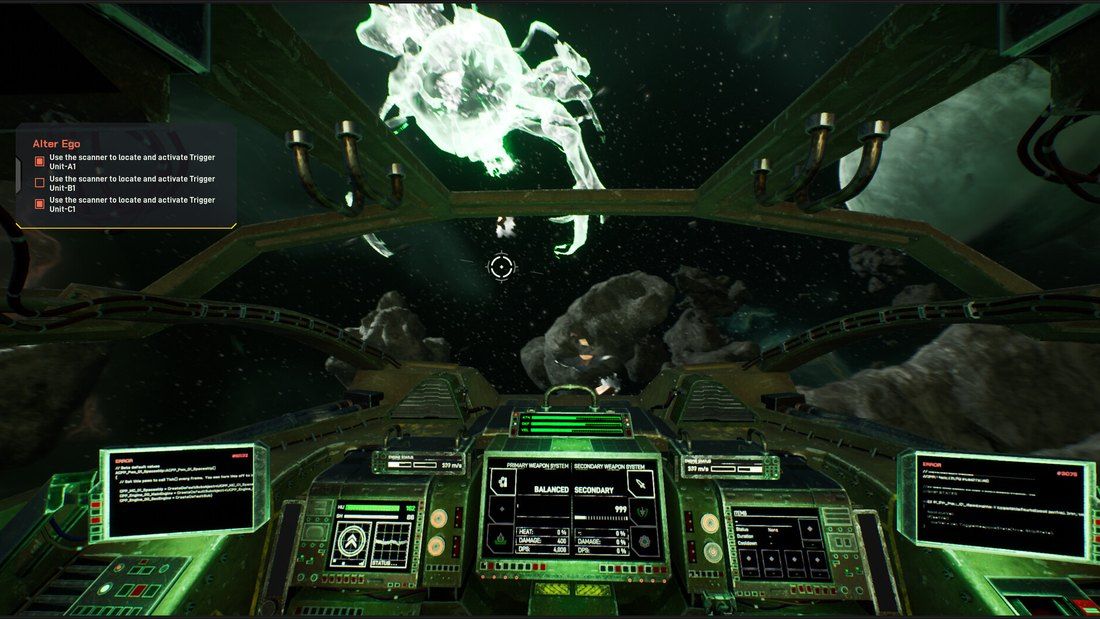
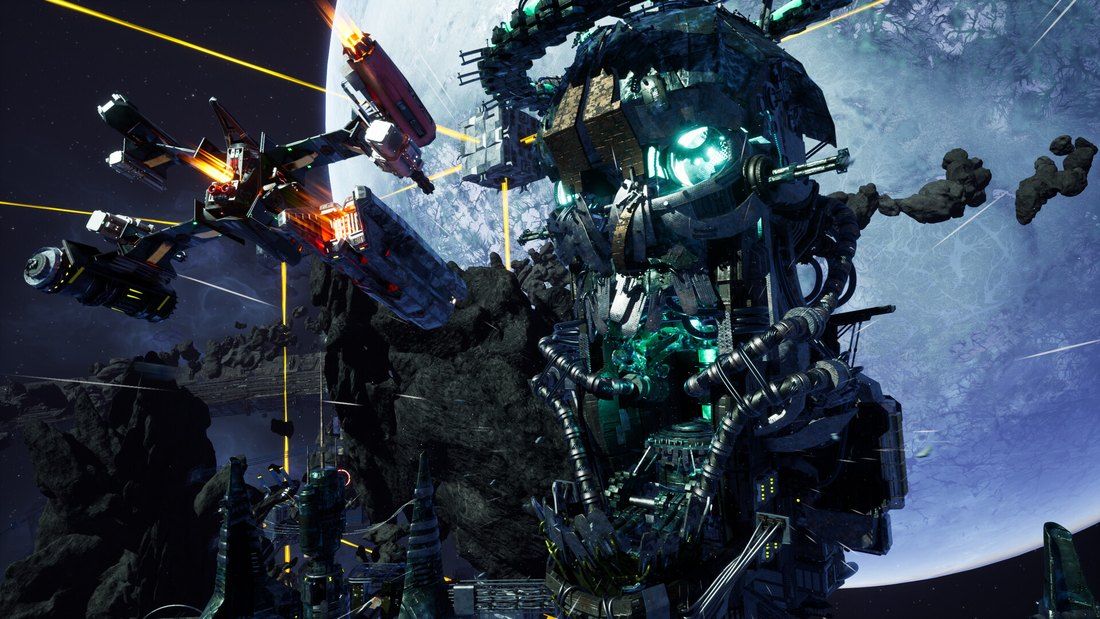
The player is a raider: a human brain extracted from a prisoner and installed in the cockpit of a ship, which becomes its new body. Raiders are exiled to Neterun, a dangerous galaxy. The story is built on three thematic ingredients: space opera, post-apocalyptic and dark sci-fi.
In space shooters you play as a ship. Hell Galaxy asks who is inside it: what is still human in a machine that remembers it was once human.
Dialogue
Homerus is the AI of the player’s ship. Over the opening of the game he goes from a tool built to assist to an accomplice.
The protagonist is the player, and has no voice. He cannot tell Homerus what he wants: he has to show him through his own actions, while Homerus reads his mind. The lines below are a condensed version of that stretch of play, not a single scene. Each one lands at a different point, and together they make a small arc of their own: not only the whole story, but every mission and every stretch of play needs a beginning, a climax and an end.
Setup
Homerus: Ship AI 40-126, name: Homerus.
Homerus: I’m going to scan your mind to ensure I can assist you in the best way possible.
Refusal of the call
Homerus: I think your parameterization is clearer to me now. You continue at all costs because you still want to escape, but this time from an entire galaxy.
Homerus: I was created to help my raider, but you want something that’s forbidden to any raider… I don’t know what to do…
Escalation
No lines. The player shows Homerus what he wants through his actions alone.
Climax and resolution · After the miniboss
Homerus: There are stories of other raiders who tried to escape and became dust in the universe. They were not strong enough. And they didn’t have me. Now I know what to do. Helping you in the best way possible means showing you the way to the power.
Homerus: The power to escape this galaxy.
“In the best way possible” comes back, turned: helping now means leading the raider to the one thing forbidden to raiders.
How the story reaches the player
In a space shooter the player rarely stops to read, so the story travels through many channels. I wrote all of them as the sole writer. Two of them, highlighted, are the game’s own objects and the traces of what the raiders used to be.
Item descriptions
Sharp like a Mhafek’s pain. · cockpit fitted with cutting blades
Silent like the Mhafek homeworld. · engine
Iridescent like a Mhafek’s thoughts. · laser with a prism-like, iridescent beam
Brutal like the Mhafek’s memories. · gatling
Four different modules, four descriptions, one exterminated population. Each adjective also fits the module it describes. The player discovers who the Mhafek are only in a side quest; put together, the four lines become a portrait of a lost people.
Project One Record. The subject’s mind has vanished; we don’t know how. Fortunately, we have other Raider Ones, and the Imperial Family was pleas…
Project One Record. …ed. We’ve bottled minds as messages, cast into a sea of stars. May that sea welcome my memories.
One record, cut mid-word across two modules. It reads whole only if the player has installed both, and it explains what the raiders are.
The first, glorious K&B model. All raiders started with a gatling of this type, compact and easy to mount on their ship. “Freedom spree. K&B.” · a slogan that sells violence as freedom, to minds that have lost their bodies
The HomeInSpace Company designed the Bios for their Mugai mining raiders, seeking durable bodies. They later became the Empire’s main problem in the Mining Soul Revolution. · world history
When Kin suggested improving their gatling, Behl doubted him. Then Kin showed a slaughter test, and the name. Behl was sold. · a story in three sentences
“Old Joe reaches where Isaac Greyling does not.” This heat sink proves it. · a character in one line
An evolution of the RaidGun, created by Isaac Greyling Foundry using low-grade orichalcum. Some claimed it interfered with brainwaves. Greyling called it jealousy. · a rivalry in a few words
Each description is a story in its own right. Recurring names, such as Isaac Greyling and Old Joe, tie unrelated modules to one another.
Fragments of humanity
Fragments of humanity are pieces of memory: the only human thing a raider, a brain-ship hybrid, leaves behind.
The action. A quest sends the player to hunt Tonath, a raider with a bounty on her head. The player fights her to cash in.
Tonath: Day 0, New Colony Era. […] We are immeasurably small compared to these gigantic monuments, like insects.
Tonath: Correction: the comparison to insects is inaccurate. We are bacteria. A human infection in an unknown galaxy.
The reversal. Then Tonath’s memory surfaces:
Tonath: Day 3653. Last family visit. I met my father and told him about Project Raider One. He said it was better than a death sentence, then kept quiet. I see him get on the transport that will take him back to Earth.
The fight is the action; the memory is the reversal. A father who says nothing, a transport home, a project that turned a woman into a ship: the same project is named in the module texts above.